

Pop the hood on two identical cars — same engine, same mileage, same driving conditions — and one will often outlast the other by a decade. Ask most owners why, and you'll hear about driving habits or luck. Ask an engine oil formulator, and you'll get a different answer: it's the additive package.
Base oil — the refined petroleum or synthetic fluid that forms the bulk of any motor oil — actually does very little of the interesting work. On its own, base oil lubricates, but it can't stop metal from corroding, can't hold soot in suspension, and can't survive the extreme heat inside a modern turbocharged engine. That work is done by a small set of additive chemistries, usually just 10–25% of the bottle by volume, that quietly decide whether an engine ages gracefully or fails early.

The Problem Engines Didn't Used to Have
For most of the last century, engine oil specifications evolved slowly. Then, in the space of about a decade, car engines changed faster than the oil designed to protect them.
Automakers worldwide shifted toward smaller, turbocharged, direct-injection engines to meet tightening fuel-economy and emissions rules. These engines run hotter, inject fuel differently, and operate under far higher cylinder pressures than the engines oil specifications were originally built around. That shift introduced a genuinely new failure mode: low-speed pre-ignition, or LSPI — a phenomenon where fuel detonates prematurely inside the cylinder, before the spark plug even fires. The resulting pressure spike can bend connecting rods, shatter spark plugs, and crack pistons, sometimes destroying an engine in a single event.
The cause turned out to trace back partly to the oil itself. Investigators found that certain oil additives — specifically, older calcium-based detergents — could actually contribute to LSPI events. That single finding forced a rewrite of engine oil chemistry across the entire industry.
Meet the Additive Package
A modern engine oil formulation is closer to a precision chemical product than a simple lubricant. The main categories at work include:
Detergents — keep high-temperature engine surfaces (pistons, rings) free of varnish and deposits.
Dispersants — keep soot and combustion byproducts suspended in the oil rather than clumping into sludge.
Anti-wear agents — form a protective film on metal-to-metal contact points, especially during cold starts before full oil pressure builds.
Antioxidants — slow the oil's own chemical breakdown as it's exposed to heat and oxygen over thousands of miles.
Viscosity modifiers — help the oil stay thin enough to flow at start-up but thick enough to protect under load and heat.

None of these ingredients act alone. Formulators describe the process as a balancing act: increasing one additive can improve one property while quietly undermining another, which is why reformulating an oil to fix one problem (like LSPI) required touching nearly the entire additive package.
When the Fix Created New Rules
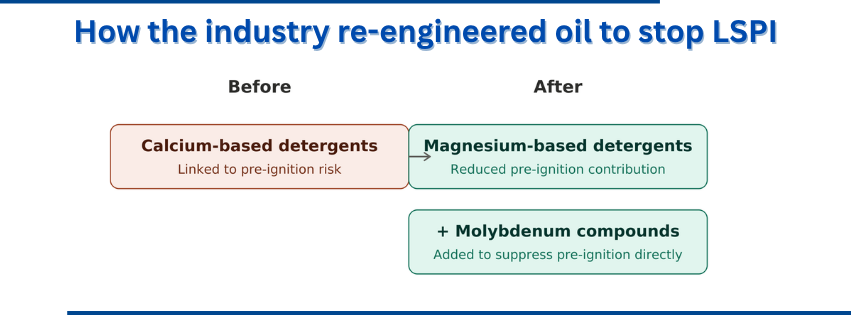
The industry's response to LSPI illustrates just how sensitive this balance is. Formulators significantly reduced calcium-based detergents — the additive linked to pre-ignition risk — and replaced much of that chemistry with magnesium-based alternatives instead, while adding molybdenum-containing compounds to help suppress pre-ignition directly.
That reformulation became the basis of new industry-wide specifications, developed jointly by engine oil standards bodies and vehicle manufacturers, requiring oils to pass dedicated pre-ignition and timing-chain-wear tests before they could carry the current performance seals found on oil bottles today. It was one of the fastest-moving updates to passenger car oil standards in decades — and it happened because of an additive-chemistry problem invisible to anyone without a lab.
The Standards Most Drivers Never Read
Every bottle of engine oil carries a small circular symbol — sometimes called the "donut" — showing which industry performance category it meets, alongside a second certification mark for fuel-economy-focused formulations. These aren't marketing badges; they represent a battery of standardized engine tests measuring wear protection, deposit control, oxidation resistance, and pre-ignition suppression, run under strict, repeatable industry protocols.
The categories are deliberately backward-compatible, meaning a current-generation oil will still protect an older engine, but the reverse often isn't true — an oil built to an older standard may lack the specific chemistry a newer turbocharged engine needs. It's a detail easy to miss at the auto parts store, where two bottles of oil can look nearly identical while representing genuinely different chemical formulations underneath.
Why This Keeps Evolving
Oil specifications aren't static because engines aren't either. As automakers keep pushing toward smaller, more efficient, more heavily loaded engines — a trend accelerated further by fuel-economy and emissions targets — new engine tests keep getting added: tests for oil thickening under stress ("gelation"), tests for maintaining pre-ignition protection as oil ages and gets dirty rather than only when it's fresh out of the bottle, and tests for compatibility with hybrid powertrains that shut engines on and off repeatedly.
Each new test typically forces another small rebalancing of the additive package. It's a quiet, continuous engineering effort that most drivers will never see — right up until they don't change their oil on schedule, or use the wrong grade, and the chemistry that was supposed to protect their engine for 300,000 miles runs out of runway at 100,000 instead.
The Real Takeaway
The gap between an engine that lasts a decade and one that doesn't often isn't about the metal at all — it's about a few percent of a bottle's contents, engineered and re-engineered against standardized tests most owners will never read the fine print on. Understanding that doesn't require a chemistry degree. It just requires knowing that the number on the oil cap — the viscosity grade and the certification marks next to it — is the difference between an educated guess and a formulation built specifically for the engine underneath your hood.