

Beyond the Oil Change: How AI and Predictive Maintenance Are Rewriting Lubricant Selection in India
For most of the last century, lubrication ran on the calendar, not on the machine. Change the oil every 5,000 kilometres. Regrease the bearing every quarter. Send a sample to the lab every six months, whether the equipment asked for it or not. It was a system built for an age when nobody could see inside the machine while it was running.
That age is ending. A sensor in the sump can now tell you, in real time, whether an oil is degrading, whether a bearing is shedding metal, or whether water has crept into a gearbox — and an algorithm can tell you what to do about it before the machine tells you itself, usually by failing. This is not a distant future. It is being deployed on Indian factory floors, wind farms, and fleet workshops right now, and it is quietly changing what "the right lubricant" even means.
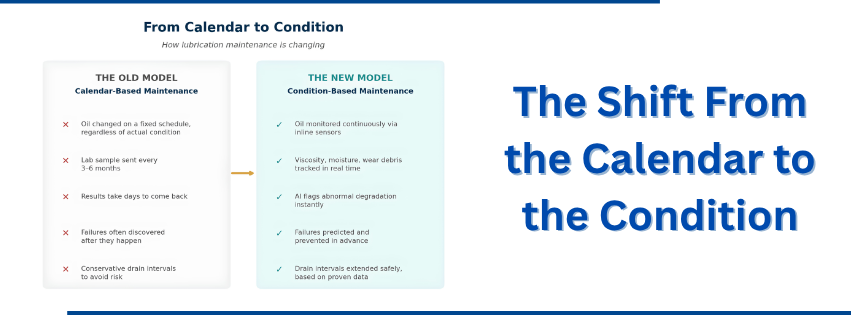
The Shift From the Calendar to the Condition
The global predictive maintenance market — the software and sensor layer that watches equipment health — was valued at roughly USD 17.5 billion in 2026 and is projected to grow at a compound annual growth rate above 27% through 2033, according to Grand View Research. India is not a bystander in this shift. The Indian predictive maintenance market alone is expected to grow from around USD 614 million in 2025 to more than USD 4 billion by 2032, a compound annual growth rate above 30%, among the fastest of any major economy tracked by industry researchers.

The specific slice of this story that touches lubricants — oil condition monitoring — is smaller but telling. Globally, the oil condition monitoring market is estimated at close to USD 2 billion in 2026, and multiple research houses point to the same underlying driver: real-time, sensor-based oil analysis is displacing the old rhythm of scheduled lab sampling. Laboratory testing still accounts for the majority of this market today, but software and analytics platforms are the fastest-growing segment — a sign that data interpretation, not just data collection, is where the value is moving.

What the Sensor in the Sump Actually Measures
Condition-based monitoring works by continuously tracking the things a lubricant quietly tells you about a machine: viscosity drift, oxidation, moisture ingress, particle counts, and metallic wear debris. Historically, this required pulling a sample and waiting days for a lab report. Now, inline sensors measuring viscosity, dielectric constant, temperature, and ferrous content can feed that data straight into an AI model that has learned what "normal" looks like for a specific gearbox, compressor, or turbine — and flags the moment it isn't.
This matters for lubricant selection in a very practical way. A formulation chosen purely on OEM specification sheets and cost is now competing with formulations chosen because their degradation signature is well understood by the monitoring software running on top of them. Lubricant companies that can supply not just the oil, but the data model that interprets it, are starting to win contracts on a different basis than price per litre.
India's Machinery Is Old — and That's Exactly the Opportunity
India's manufacturing base presents an unusual setup for this technology. The country's manufacturing gross value added crossed ₹35 lakh crore in FY2024, yet a large share of the installed machinery base is 15 to 25 years old, built long before connectivity or condition monitoring was a design consideration. Retrofitting that base — rather than replacing it — is where predictive maintenance and, by extension, smarter lubrication programmes are finding their first serious traction.
The policy backdrop is pushing in the same direction. Production-Linked Incentive schemes across 14 manufacturing sectors, the Make in India and Digital India programmes, and the IndiaAI Mission — approved by the Union Cabinet in March 2024 with an outlay of ₹10,371.92 crore over five years to build out India's AI computing and application ecosystem — are collectively lowering the cost of deploying AI-based monitoring across asset-heavy industries. On the energy side, the Ministry of Power projects India's electricity demand will reach 277.2 GW by 2026–27 and 366.4 GW by 2031–32, and utilities are already deploying AI-enabled condition monitoring on transformers, turbines, and grid infrastructure to keep pace — infrastructure that runs on gear oils, transformer oils, and turbine lubricants whose condition now needs to be provable in real time, not assumed on a schedule.
India's lubricants market itself is expected to reach roughly 5.77 billion litres in 2026, growing toward 6.73 billion litres by 2031, according to Mordor Intelligence — and the same report explicitly names the rollout of digital condition-monitoring solutions, alongside BS-VI regulation and synthetic premiumization, as one of the forces reshaping demand. Organised fleet operators adopting predictive maintenance are sustaining lubricant volumes even as extended drain intervals would otherwise shrink them — because knowing exactly when an oil needs changing, rather than guessing conservatively, changes the economics for both the buyer and the blender.
What This Means for Formulators and Blenders
Three shifts are worth watching closely.
First, extended and validated drain intervals are becoming a selling point rather than a risk. When condition data can prove an oil is still fit for service, operators are willing to run it longer — which rewards lubricants engineered for stable long-term performance and penalises commodity formulations that degrade unpredictably.
Second, data compatibility is becoming a specification in its own right. Just as OEMs specify viscosity grades and additive packages, monitoring platforms increasingly expect a lubricant's degradation behaviour to be documented and predictable, so it can be modelled. Formulators who can hand a customer both the oil and its digital "signature" have a real edge.
Third, the renewable energy and heavy industrial segments — where unplanned downtime is most expensive — are moving fastest. Globally, renewable energy is the fastest-growing end-user vertical for oil condition monitoring, and in India, wind, grid, and industrial automation infrastructure are all being built with monitoring baked in from day one, not retrofitted later.
The Global Picture, in Brief
This is not an India-only story. In the United States and Europe, sensor cost declines of roughly 40% since 2020 and regulatory pushes like the EU Machinery Regulation are compelling asset-heavy industries to embed condition monitoring directly into new equipment. Asia-Pacific, however — anchored by India, China, and Japan's expanding automation and Industry 4.0 programmes — is consistently flagged by market researchers as the fastest-growing region for both predictive maintenance broadly and oil condition monitoring specifically. For a lubricants industry built on regional distribution networks and long OEM relationships, that regional lead is worth paying close attention to.
The Bottom Line
The lubricant is no longer just a consumable that gets replaced on schedule. Increasingly, it is a live data source — and the companies that treat it that way, building formulations and services around what the oil is telling the machine in real time, are the ones positioned to lead as India's industrial base modernises around them.